

Irregular periods, stubborn weight gain, restless nights, sudden hot flushes, low mood that seems to arrive from nowhere: hormonal imbalance rarely shows up as a single symptom. If you are searching for Ayurvedic treatment for hormonal imbalance in London, you are likely looking for care that sees the whole picture rather than one symptom at a time, whether that is support through perimenopause and menopause with Ayurveda or natural fertility care while you try to conceive.
Keyajee, an Ayurvedic clinic in London founded in 2008 by Vaidya Seema Datta, brings more than 25 years of clinical experience in women’s health, combining classical Ayurvedic diagnosis with evidence-informed modern care. If you already know you would like personal guidance, you can book a free consultation with Seema online or in person.
This guide explains how Ayurveda understands hormonal balance, what the medical evidence says, and how a personalised plan can support you through PCOS, irregular cycles and menopause. You will also find practical daily habits you can start today. Your gut plays a bigger role than you might think, as we explore in our article on the link between hormonal imbalance and gut health.
What Is Hormonal Imbalance? Signs Women Should Not Ignore
Hormones are chemical messengers. Oestrogen, progesterone, testosterone, insulin and thyroid hormones work together like an orchestra, and when one falls out of tune the effects ripple across your periods, skin, weight, energy and mood. Because these systems are so closely connected, a problem in one area, such as blood sugar, can show up somewhere unexpected, such as your skin or your cycle.
Common signs of hormonal imbalance include:
- Irregular, missed or very heavy periods
- Acne, oily skin, excess facial or body hair, or hair thinning
- Weight gain or difficulty losing weight, especially around the middle
- Persistent tiredness and poor sleep
- Anxiety, low mood, irritability or brain fog
- Hot flushes and night sweats
- Low sex drive or vaginal dryness
- Difficulty getting pregnant
When to See Your GP First
These symptoms can have several causes, so a medical check is always the right first step. The NHS advises seeing a GP if you think you may have PCOS or if symptoms are affecting your everyday life, work or relationships. If menopausal symptoms begin before the age of 45, your GP may also suggest tests. Ayurveda for hormonal balance then works best as complementary, natural hormonal balance support alongside, rather than instead of, a proper diagnosis.
How Ayurveda Understands Hormonal Imbalance
When it comes to hormonal imbalance, Ayurveda looks beyond individual hormones to the underlying patterns in your body and mind. Rather than asking only “which hormone is wrong?”, an Ayurvedic practitioner asks “what has pulled this person out of balance, and how can we bring her back?”
The Three Doshas and Your Hormones
Ayurveda describes three doshas, or functional energies, that govern everything in the body. Every woman is born with her own unique combination, called her Prakriti. When a dosha becomes aggravated by stress, diet, poor sleep, seasonal change or life transitions, Ayurveda teaches that symptoms begin to appear.
| Dosha | Elements | What it governs | Traditional signs of imbalance |
|---|---|---|---|
| Vata | Air and space | Movement, the nervous system, the flow of menstruation | Irregular or painful periods, anxiety, dryness, poor sleep, constipation |
| Pitta | Fire and water | Heat, metabolism, digestion, hormones | Heavy periods, irritability, heat, acne, inflammation |
| Kapha | Earth and water | Structure, stability, fluid, nourishment | Weight gain, sluggishness, water retention, slow or absent cycles |
This is why two women with the same diagnosis may receive very different Ayurvedic plans. One woman with PCOS may show strong Kapha signs, while another shows more Vata or Pitta.
Agni: Why Digestion Matters for Hormonal Balance
Ayurveda places Agni, your digestive fire, at the centre of good health. According to Ayurvedic teaching, when digestion is sluggish, food is not fully processed and the body struggles to nourish its tissues, including the reproductive tissue. Undigested residue, called Ama, is believed to block the body’s channels and disturb the doshas.
That is why many women begin with gentle gut support, such as our guided Deep Digestive Reset programme or our seasonal Autumn Digestive Reset, before or alongside hormonal care.
Hormones Through Life’s Seasons
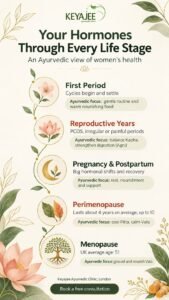
Ayurveda also links each stage of life to a dominant dosha. Childhood is traditionally seen as the Kapha stage, the adult and reproductive years as the Pitta stage, and later life as the Vata stage. Major hormonal shifts, from your first period to menopause, happen at the points where one stage gives way to the next. Seeing these changes as natural transitions, rather than failures of the body, is one of the most reassuring ideas Ayurveda offers women.
Ayurvedic Treatment for PCOS in London
Understanding PCOS from a Medical Perspective
PCOS is one of the most common hormonal conditions in women, affecting an estimated 5–20% of women of reproductive age worldwide. The NHS now calls it polyendocrine metabolic ovarian syndrome (PMOS), and notes that symptoms usually start around puberty. You may be more likely to have it if a close relative does or if you are from an Asian background.
Despite the old name, you do not need cysts on your ovaries to have PCOS. Doctors usually diagnose it when you have two of three features: irregular or absent periods, signs of high testosterone (such as excess hair or acne) or raised testosterone on a blood test, and polycystic ovaries on a scan.
Insulin plays a central role. NHS guidance from Leeds Teaching Hospitals explains that higher-than-normal insulin levels cause the ovary to produce more testosterone, and that weight gain often makes symptoms worse. Over time, PCOS can increase the risk of type 2 diabetes, high blood pressure, heart disease, fatty liver disease and womb cancer, which is why regular check-ups matter. There is no cure, but treatment and lifestyle changes can make a real difference.
How Ayurveda Approaches PCOS
In Ayurveda, PCOS is often associated with aggravated Kapha, which slows metabolism and blocks the channels of the reproductive system, frequently alongside weakened Agni. An Ayurvedic plan for PCOS may focus on:
- Lighter, warm, freshly cooked meals, with fewer heavy, cold, sugary and processed foods
- Regular movement that gets you warm and slightly out of breath, which also matches NHS advice to exercise regularly
- Consistent mealtimes and sleep, to steady blood sugar and energy
- Stress support, as stress disturbs all three doshas
- Carefully selected herbs, prescribed by a practitioner only
A 2023 scoping review of Ayurveda studies in women with PCOS found a number of clinical studies suggesting a promising role in managing symptoms, while highlighting that more high-quality research is needed.
Seema has written in depth about PCOS and Ayurveda from a London practitioner’s perspective. If weight is a particular concern, our guide to managing PCOS-related weight gain with Ayurveda is a helpful next read.
Ayurveda for Irregular Periods and Painful Cycles
In Ayurveda, your menstrual cycle is seen as a monthly report on your overall health. A regular, comfortable period suggests that the doshas are in balance, while irregular, painful, very heavy or scanty periods are signs that something needs attention.
Irregular or painful periods are most often linked to disturbed Vata, the dosha of movement and flow. Heavy, hot or inflamed periods tend to point towards Pitta, and slow or delayed cycles towards Kapha. Our Ayurvedic menstruation wellness guide covers each pattern in more detail.
A Simple Ayurvedic Daily Rhythm for Hormonal Balance
Practical Ayurvedic support centres on Dinacharya, your daily rhythm. Small, consistent habits help steady the nervous system and support a more predictable cycle:
- Wake and sleep at regular times, ideally winding down before 10pm.
- Start with warm water rather than cold drinks first thing.
- Make lunch your main meal, when Ayurveda considers digestion strongest.
- Choose warm, cooked, seasonal food over raw and cold meals, especially in autumn and winter.
- Try gentle self-massage with warm oil (Abhyanga) before bathing, a deeply calming Vata practice.
- Move mindfully every day, with walking, yoga or stretching.
- Rest more around your period, rather than pushing through as normal.
For more ideas, see our Ayurvedic period care tips, and learn why cramps happen in period pain explained through Ayurveda.
Ayurvedic Menopause Treatment in London
In the UK, the average age of menopause is 51, and it usually happens between 45 and 55. Around 1 in 100 women reach menopause before the age of 40, known as premature ovarian insufficiency. Perimenopause, the lead-up to your final period, lasts around four years on average but can continue for up to ten. You are considered post-menopausal once you have gone 12 months without a period.
Common Menopause Symptoms
According to NICE estimates, around 80% of women going through menopause experience hot flushes and night sweats. NHS guidance lists many other symptoms too, including tiredness, low mood, anxiety, brain fog, poor sleep, joint pains, vaginal dryness, low sex drive and changes to skin and hair.
Ayurveda sees menopause as a natural move from the Pitta stage of life into the Vata stage. Symptoms are understood through the doshas, which helps shape a personalised plan:
| Symptom | Ayurvedic view | Supportive approach |
|---|---|---|
| Hot flushes, night sweats, irritability | Excess Pitta (heat) | Cooling foods, less caffeine, alcohol and spice, calming breathwork |
| Anxiety, poor sleep, dryness, joint aches | Rising Vata | Warm oil massage, regular routine, nourishing warm meals, rest |
| Weight gain, sluggishness, low motivation | Kapha imbalance | Daily movement, lighter meals, supporting Agni |
Encouragingly, this overlaps with NHS advice. The West Suffolk NHS menopause leaflet notes that regular exercise can reduce hot flushes and help sleep, that caffeine and alcohol can trigger hot flushes, and that vitamin D, calcium and weight-bearing exercise help keep bones strong.
What Research Says About Shatavari and Ashwagandha
Shatavari (Asparagus racemosus) is one of the herbs most traditionally used for women in Ayurveda. In recent eight-week, randomised, placebo-controlled trials in menopausal women, Shatavari root extract was associated with improvements in menopausal symptoms. One three-arm trial that also tested Shatavari combined with Ashwagandha reported significant improvements in mood and self-esteem, with only mild side effects. The researchers were clear that longer and larger studies are still needed, so these herbs should be seen as promising support rather than proven cures.
Our Ayurvedic menopause programme is tailored to your constitution, symptoms and life stage. You can also read how Ayurveda can relieve early symptoms of menopause. For deeper rebalancing, some women choose Panchakarma detox therapy, and our article asks whether Panchakarma can help manage menopause symptoms naturally.
Hormonal Balance, Fertility and Pregnancy
The WHO describes PCOS as one of the most common causes of infertility, and hormonal balance is closely tied to your chances of conceiving. In Ayurveda, preparing the body before conception is considered just as important as care during pregnancy. A balanced cycle, strong digestion and a calm mind are all seen as the foundation for a healthy pregnancy.
At Keyajee, many women begin with hormonal support and continue with our Ayurvedic fertility programme. Our guide on how to boost your fertility with Ayurveda shares practical first steps.
When that journey leads to motherhood, Seema continues to support you with Ayurvedic pregnancy care and childbirth preparation, drawing on her training as a Gentle Birth Method practitioner and doula.
What to Expect from an Ayurvedic Doctor for Hormonal Imbalance at Keyajee
Every journey at Keyajee begins with listening. Your care follows three simple steps:
- In-depth consultation. Seema uses time-honoured diagnostic methods, including pulse reading, tongue analysis and dosha assessment, alongside a detailed conversation about your cycle, digestion, sleep, emotions and medical history.
- A personalised plan. This may include diet and seasonal eating guidance, a daily routine designed around your dosha, carefully chosen herbs, stress and sleep support, and therapies such as Panchakarma where appropriate.
- Ongoing support. Hormonal balance takes time, so your plan is reviewed and adjusted as your body responds.
Our guide to what happens at your first Ayurvedic consultation walks you through it. Online consultations run on Mondays, Tuesdays, Wednesdays and Fridays, and in-person appointments take place on Saturdays at our Ayurvedic clinic in Marylebone, near Baker Street.
Choosing a practitioner is an important decision. Our guide on what to look for in the best Ayurvedic clinic in London explains the questions worth asking.
Safe, Practitioner-Led Care That Works Alongside Your GP
Natural does not automatically mean safe. The MHRA, the UK’s medicines regulator, has warned about unlicensed Ayurvedic and traditional remedies found to contain mercury, lead and arsenic, so never self-prescribe herbs bought online from unknown sellers. At Keyajee, every recommendation comes from an experienced practitioner and complements, rather than replaces, your GP or specialist. Always tell your doctor about any herbs you take, and never stop prescribed medication without speaking to them first.
Take the First Step with Women’s Health Ayurveda in London
Hormonal imbalance can feel exhausting, but you do not have to face it alone. Understanding your body is the first step towards feeling like yourself again. If you are living with PCOS symptoms, the NHS guide to polyendocrine metabolic ovarian syndrome is a useful starting point for understanding your medical options.
For women approaching midlife, the House of Commons Library’s briefing on menopause symptoms and support in the UK sets out NICE guidance and statistics clearly. Ayurveda then offers a gentle, personalised way to support your body through this natural transition.
If you would like to explore the research yourself, this scoping review of Ayurveda studies in women with PCOS gives an honest picture of both the promise and the gaps. When you are ready, book your free consultation with Vaidya Seema Datta or get in touch with our team. Your next chapter of balance starts here.
Frequently Asked Questions
1. What is the best Ayurvedic treatment for hormonal imbalance in London?
The most effective Ayurvedic treatment for hormonal imbalance is personalised to your dosha, symptoms and life stage. At Keyajee, Vaidya Seema Datta combines diet, daily routine, herbs and, where appropriate, Panchakarma into an individual plan.
2. Can Ayurveda cure PCOS?
The NHS states PCOS (now PMOS) has no cure, but symptoms can be managed with treatment and lifestyle changes. Ayurveda supports symptom management through diet, routine, movement and herbs, ideally alongside medical care.
3. Does Ayurveda help with irregular periods?
Ayurveda links irregular periods mainly to imbalanced Vata. Regular routines, warm nourishing food, oil massage and stress support may help your cycle settle. Always check persistent irregularity with your GP.
4. Is Ayurvedic menopause treatment an alternative to HRT?
Keyajee’s menopause care does not rely on hormone replacement, but it can sit alongside HRT if you and your doctor choose it. The right choice depends on your symptoms and health history.
5. Are Ayurvedic herbs safe for hormonal balance?
Only under a qualified practitioner’s guidance. The MHRA has warned about unlicensed products containing heavy metals, so always buy from trusted sources and tell your GP what you take.
6. How long does Ayurvedic treatment for hormonal imbalance take?
It varies from woman to woman. Hormonal changes build up over months or years, so Ayurveda focuses on steady, lasting change. Your practitioner will review your progress and adjust your plan along the way.
7. Can I have an Ayurvedic consultation online?
Yes. Online consultations run on Mondays, Tuesdays, Wednesdays and Fridays, with in-person appointments on Saturdays near Baker Street. You can also call +44 7588 891 824.


