
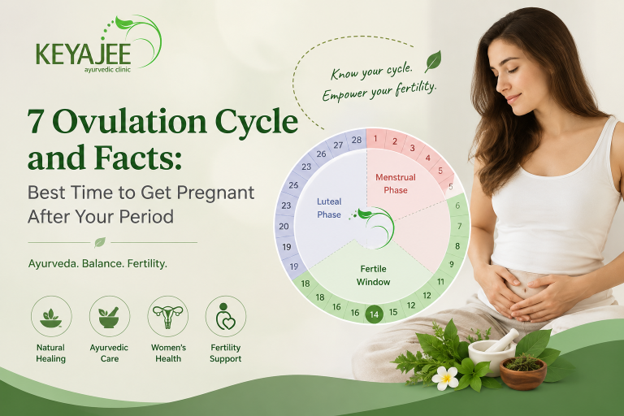
If you are trying to conceive, understanding your ovulation cycle is the single most useful thing you can do. Most couples assume that conception can happen at any point in the month, but biology is far more specific than that. There is a narrow window each cycle when pregnancy is possible, and knowing when it opens changes everything.
At Keyajee, our approach blends modern reproductive understanding with the classical wisdom of Ayurveda. As an Ayurveda fertility clinic in London, we see many women who have been tracking apps and calendars for months without ever being told how their cycle actually works. Here are seven facts that matter most.
Fact 1: Ovulation Is a Single Event, Not a Phase
Ovulation is the release of a mature egg from the ovary, and it happens in a matter of minutes. What people often call “the ovulation phase” is really the fertile window surrounding that release.
Once the egg is released, it survives for roughly 12 to 24 hours. If it is not fertilised in that time, it dissolves and the cycle moves toward menstruation. This is why timing matters so much. The egg is not waiting around for weeks.
In Ayurvedic terms, this release is governed by Apana Vata, the downward moving energy that controls all reproductive and eliminative functions. When Apana Vata is disturbed by stress, irregular sleep, cold foods, or excessive travel, ovulation can become erratic or delayed.
Fact 2: Your Fertile Window Is About Six Days Long
Here is where the menstrual cycle and pregnancy connection becomes clearer. Although the egg lives for less than a day, sperm can survive inside the female reproductive tract for up to five days in fertile cervical mucus.
That gives you a fertile window of approximately six days: the five days before ovulation plus the day of ovulation itself. The highest chance of conception falls on the two days immediately before ovulation and the day it occurs.
This is one of the most misunderstood parts of the fertility period cycle. Many couples time intercourse for the day after ovulation, by which point the window has usually closed.
Fact 3: Day 14 Is an Average, Not a Rule
The textbook 28 day cycle with ovulation on day 14 describes a minority of women. Real cycles range from 21 to 35 days and can vary by several days from month to month.
The more reliable measure works backwards. The luteal phase, from ovulation to your next period, is fairly consistent at around 12 to 14 days for most women. So if your cycle is 32 days, ovulation likely occurs around day 18, not day 14. If your cycle is 24 days, it may occur around day 10, which means your fertile window overlaps with the tail end of your period.
Tracking your own cycle length for three months gives you far better fertility days than any generic calculator.
Fact 4: Your Body Gives Clear Signals
You do not need expensive equipment to identify ovulation. Your body announces it.
Cervical mucus is the most useful sign. After your period it is scant and sticky. As oestrogen rises, it becomes creamy, then clear, slippery, and stretchy, resembling raw egg white. This fertile mucus nourishes sperm and helps them travel. Its appearance signals that your fertile window is open.
Other signals include a slight rise in basal body temperature after ovulation, mild one sided pelvic pain known as mittelschmerz, increased libido, breast tenderness, and a softer, higher cervix.
Ayurveda has described these observations for centuries through the concept of Ritukala, the fertile period, noting changes in the quality of secretions, mood, warmth, and appetite as markers of readiness for conception.
Fact 5: Early Pregnancy Signs Overlap With Premenstrual Signs
Many women search for symptoms of getting pregnant in the two week wait and find themselves confused. This is because progesterone rises after ovulation whether or not conception occurs, producing tiredness, tender breasts, mood shifts, and mild cramping in both cases.
The signs more specific to early pregnancy include implantation spotting around six to twelve days after ovulation, a basal body temperature that stays elevated beyond fourteen days, heightened sense of smell, and nausea that appears from around week five or six.
A test taken after your missed period remains the only reliable answer. Testing too early produces false negatives and unnecessary distress.
Fact 6: You Can Ovulate Soon After Your Period Ends
The question of the best time to get pregnant after your period does not have one answer, because it depends entirely on your cycle length.
With a 28 to 32 day cycle, ovulation typically falls between days 14 and 18, giving you a fertile window from roughly day 9 or 10 onwards. Intercourse every other day from day 9 through day 18 covers it comfortably.
With a short cycle of 21 to 24 days, ovulation may occur as early as day 8 to day 10. If your period lasts six days and sperm survive five days, conception from intercourse during your period is genuinely possible.
With longer or irregular cycles, ovulation may be delayed or absent in some months. This is where professional assessment becomes valuable rather than guesswork.
Fact 7: Ovulation Quality Responds to How You Live
Ovulation is not fixed. It reflects your nutritional state, stress load, sleep, thyroid function, and weight. Chronic stress raises cortisol, which suppresses the hormonal signals that trigger egg release. Undereating, overexercising, and poor sleep all delay or prevent ovulation.
Ayurveda to increase fertility works on this principle directly. The classical texts describe Shukra dhatu, the reproductive tissue, as the final and most refined product of digestion. If digestion is weak or the body is burdened with ama, or metabolic residue, reproductive tissue is poorly nourished no matter what supplements are taken.
At our Ayurvedic clinic in London, treatment typically involves individualised dietary guidance based on your constitution, herbal formulations such as Shatavari and Ashoka where appropriate, cycle regulation through Panchakarma therapies, and fertility massage using warm medicated oils across the lower abdomen and lower back. Fertility massage supports pelvic circulation, softens tension in the reproductive organs, and helps regulate Apana Vata. Alongside this, we address sleep, stress, and daily routine, because these are not peripheral to fertility. They are central to it.
When to Seek Support
Consider a consultation if you are under 35 and have been trying for twelve months, or over 35 and trying for six months. Also seek help sooner if your cycles are consistently shorter than 21 days or longer than 35, if you have very painful or heavy periods, if you have a diagnosis of PCOS, endometriosis, or thyroid dysfunction, or if you have experienced recurrent miscarriage.
Working With Your Cycle
Your ovulation cycle is not an obstacle to work around. It is information. Track your cycle length, watch your cervical mucus, notice your patterns over three months, and you will know your fertile days better than any app can guess them.
Keyajee is a women’s health clinic in London offering Ayurvedic fertility care rooted in individual assessment rather than generic protocols. If you would like a consultation with an Ayurvedic doctor in London to understand your cycle and what may be affecting it,


