
Searching for Ayurvedic medicine in London usually means one of two things. You want a gentler, more personal approach to your health, or you’ve been handed a jar of herbs and want to know if it’s safe. Both are good instincts. The safest way to use Ayurvedic herbs is not guesswork from a shop shelf or a website. It’s a proper Ayurvedic consultation in London with a qualified practitioner who looks at your whole picture first.
At Keyajee Ayurvedic Clinic, that practitioner is Vaidya Seema Datta. She trained in Ayurveda in Nagpur, India, and founded Keyajee in 2008. She brings more than 25 years of clinical experience, much of it in women’s health, from Ayurvedic fertility care to menopause support.
This guide covers what Ayurvedic herbal medicine is and what happens in a consultation. It also explains what the evidence says about popular herbs, how the UK regulates them, and how to choose a practitioner you can trust. If you’re completely new to Ayurveda, start with our walkthrough of what happens at your first Ayurvedic consultation.
What Is Ayurvedic Herbal Medicine?
Ayurveda is one of the world’s oldest medical systems, and it remains one of India’s traditional healthcare systems. Ayurvedic herbal medicine usually combines plant-based preparations with diet, exercise and lifestyle. Some traditional preparations also include animal, metal or mineral ingredients. That detail matters for safety, as you’ll see below.
Herbs are rarely the whole story. Whether you’re exploring Ayurvedic medicine in London for the first time or returning to it, a good practitioner looks at your constitution (Dosha), the strength of your digestion (Agni) and your daily habits before deciding whether herbs are needed at all. Often, changes to food, sleep and routine come first.
What does the research say?
The honest answer is that the evidence is promising in places but still limited. The US National Center for Complementary and Integrative Health (NCCIH) makes three points:
- A few studies suggest Ayurvedic preparations may reduce pain and improve function in osteoarthritis.
- Some may help manage symptoms in type 2 diabetes.
- Most of these trials are small or not well designed.
This is why a personalised, cautious approach makes sense. Our guide to natural remedies for digestive issues shows how much can be achieved through food and routine alone.
|
Herb |
Traditional use and research |
Key cautions |
| Ashwagandha | Some preparations may help with insomnia and stress. Evidence on anxiety is unclear. | May be safe short term (up to 3 months); long-term safety unknown. Rare cases of liver injury. Avoid in pregnancy and breastfeeding, and with thyroid or autoimmune conditions. |
| Turmeric | Early evidence for knee osteoarthritis is positive, but better-quality studies are needed. | Liver damage has been reported with some highly bioavailable curcumin products. |
| Triphala | A classic three-fruit formula. Studies are mixed, and more rigorous trials are needed. | Found safe for 25 days to 1 year in reviewed studies, but long-term data are limited. |
Ashwagandha deserves a special mention for UK readers. The Food Standards Agency (FSA) has been reviewing its safety because incidents linked to ashwagandha supplements have been rising. There is currently no established safe level for ashwagandha in UK food supplements. This doesn’t mean the herb is dangerous for everyone. It does mean that self-prescribing from an online shop is not a sensible idea.
What Happens at an Ayurvedic Herbal Consultation for Ayurvedic Medicine in London?
A genuine Ayurvedic herbal consultation is unhurried and thorough. If you’re seeking Ayurvedic medicine in London, a good consultation should include the following steps:
- A full health history. This covers your symptoms, past illnesses, and your menstrual and reproductive health where relevant.
- Your constitution and imbalances. Your practitioner assesses your Dosha, your digestion, and your patterns of sleep, energy and stress.
- A medicines and supplements review. You’ll be asked about everything you take, including over-the-counter products. This is a crucial safety step.
- A personalised plan. Diet, daily routine, self-care and breathwork usually come first. Herbs are added only where appropriate.
- Follow-up. Progress is reviewed and the plan is adjusted.
At Keyajee, this personalised model runs through every programme. Our Ayurvedic menopause support begins with a full consultation, online or in clinic. It assesses your constitution, symptom patterns, lifestyle and stress levels.
How to prepare for your consultation
- Bring or list every medicine, supplement and herbal product you take.
- Note your main symptoms, when they started and what makes them better or worse.
- Keep a simple three-day food and sleep diary.
- Write down your questions, especially about herbs and interactions.
Consultations are available online on Mondays, Tuesdays, Wednesdays and Fridays, and in person at our Baker Street clinic on Saturdays. You can read more about our Ayurvedic clinic in Marylebone.
Are Ayurvedic Herbs Safe? What the Evidence Says
If you’re asking “are Ayurvedic herbs safe?”, you deserve a straight answer. Many herbs are low risk when they are well sourced, correctly prescribed and used by the right person. But three risks matter: contamination, interactions and suitability.
Risk 1: Heavy-metal contamination
A 2008 study in JAMA tested 193 Ayurvedic products bought online. It found that 20.7%, roughly one in five, contained detectable lead, mercury or arsenic.
- Products from the rasa shastra tradition, which deliberately include metals and minerals, were more than twice as likely to contain them.
- Every metal-containing product exceeded at least one safety standard for daily intake.
- 75% of those products claimed Good Manufacturing Practice or heavy-metal testing.
That last finding is important: a label claim alone is not proof of safety.
The UK is not immune. The MHRA has warned that unlicensed Ayurvedic remedies with dangerously high heavy-metal levels may be on the UK market. In 2004, a product bought from a London outlet was linked to a case of lead poisoning.
Risk 2: Interactions with your medicines
The NHS lists several types of medicine that may not mix well with herbal medicines:
- statins
- antidepressants
- diabetes medicines such as metformin
- blood pressure medicines such as ramipril
- blood thinners such as warfarin
- hormonal contraception such as the combined pill
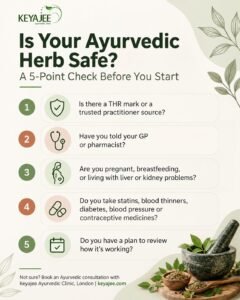
Mixing them may cause harmful effects or stop your medicine from working. The NHS advises checking with a pharmacist before taking a herbal medicine alongside any other medicine, including ones bought without a prescription.
Risk 3: Suitability for you
The NHS says you should not take herbal medicines if you:
- are pregnant or breastfeeding
- have kidney or liver problems
- take certain prescribed medicines
Herbal medicines are also not recommended for children, because not enough is known about their safety.
If you’re expecting, Ayurvedic support should focus on safe, non-herbal approaches such as diet and daily routine, agreed with your midwife. Explore Ayurvedic pregnancy care with a practitioner who knows your full history.
How Ayurvedic Medicine in London Is Regulated
The UK regulatory picture is patchy, so it helps to understand it before choosing Ayurvedic medicine in London:
- Practitioners: Ayurvedic practitioners are not statutorily registered healthcare professionals. Oversight comes mainly from voluntary professional bodies.
- Products: Herbal products can be registered with the MHRA under the Traditional Herbal Registration (THR) scheme. THR covers safety and quality, but not how well a product works. The NHS advises looking for the THR mark and an MHRA product code on the packaging.
- Practitioner supply: UK medicines law allows herbal practitioners to supply unlicensed remedies to an individual after a one-to-one consultation. This makes a practitioner’s own sourcing standards especially important.
- The NHS: Herbal medicines are not available on the NHS, so Ayurvedic medicine in London is offered privately.
Buying Ayurvedic Remedies Online vs Through a Practitioner
It’s tempting to order Ayurvedic remedies online, but the NHS specifically advises against buying unlicensed herbal medicines online, because they may not be safe.
Working with a practitioner gives you three safeguards a website can’t:
- a plan based on your individual health
- a check for interactions with your medicines
- someone to review your progress and stop or change herbs if needed
How to Choose an Ayurvedic Practitioner in London
Use this checklist before booking with any Ayurvedic doctor in London.
Green flags
- Clear training and qualifications, plus years of clinical practice.
- Membership of a professional organisation. The NHS recommends choosing one accredited by the Professional Standards Authority (PSA).
- Transparency about where herbs come from and how they are tested.
- Questions about your medicines, and encouragement to keep your GP informed.
Red flags
- Promises to “cure” serious conditions.
- Advice to stop prescribed medicines.
- Metal- or mineral-based preparations offered without explanation.
- No follow-up or monitoring.
We go deeper in our guide to finding the best Ayurvedic clinic in London.
Ayurvedic Treatment in London with Keyajee
Keyajee’s programmes combine herbs (where appropriate) with diet, routine and hands-on care.
Seasonal digestive health. Our Autumn Digestive Reset runs as a live online programme from 5 to 19 October 2026, with an introductory session on 2 October. It includes:
- daily live sessions with Vaidya Seema Datta
- a recipe book and shopping list
- diet guidance tailored to your Dosha
- self-care practices such as Abhyanga and Pranayama
For more background, read how to reset your metabolism with Ayurveda this autumn.
Deeper detoxification. Our Panchakarma treatment includes an optional women-only residential retreat, with personalised therapies, seasonal meals and daily guidance.
Hormonal and reproductive health. Many women come to us for cycle, fertility and hormone concerns. Our article on PCOS and Ayurveda explains our approach.
Birth and beyond. Our Ayurvedic childbirth preparation covers labour stages, pain management, birth plans and postnatal recovery.
Looking for a meaningful gift? An Ayurvedic consultation gift voucher lets someone you love begin their own journey.
Start Your Ayurvedic Journey Safely
Ayurveda can be a gentle, personal route to better health, provided your herbs are right for you, properly sourced and reviewed over time. Before starting any remedy, read the NHS guidance on herbal medicines and complementary therapies. It explains who should avoid herbs and which medicines they may affect.
If you ever suspect a side effect from a herbal product, report it through the MHRA Yellow Card scheme. The scheme accepts reports on herbal and complementary remedies as well as conventional medicines.
For a balanced look at the research, the NCCIH overview of Ayurvedic medicine is well worth reading. Every trustworthy source points to the same advice: get personalised, professional guidance. When you’re ready, book your Ayurvedic consultation with Vaidya Seema Datta, online or at our Baker Street clinic, and take the first step towards balanced, informed care.
Frequently Asked Questions
- What is an Ayurvedic herbal consultation?
It’s a one-to-one assessment of your health history, constitution, digestion, lifestyle and current medicines. It leads to a personalised plan that may include diet, routine and, where appropriate, herbs. - Are Ayurvedic herbs safe to take with prescription medicines?
Not automatically. The NHS warns that herbal medicines may interact with statins, antidepressants, diabetes and blood pressure medicines, warfarin and the combined pill. Always check with a pharmacist first. - How do I find a qualified Ayurvedic practitioner in London?
Check their training and years in practice, and whether they belong to a professional organisation (ideally PSA-accredited). Ask how they source their herbs. Avoid anyone who promises cures. - Is Ayurvedic medicine regulated in the UK?
Only partly. Practitioners aren’t statutorily regulated. Some herbal products carry an MHRA THR mark, which covers safety and quality but not effectiveness. - Is ashwagandha safe?
It may be safe short term for many adults. However, it should be avoided in pregnancy and breastfeeding and by people with thyroid or autoimmune conditions. It may also interact with several medicines. The FSA has been reviewing its safety in UK supplements. - Can I have an Ayurvedic consultation online?
Yes. Keyajee offers online consultations on Mondays, Tuesdays, Wednesdays and Fridays, and in-person appointments at our Baker Street clinic on Saturdays. - Is Ayurvedic treatment available on the NHS?
No. Herbal medicines are not available on the NHS, and Ayurveda in the UK is offered privately.


