
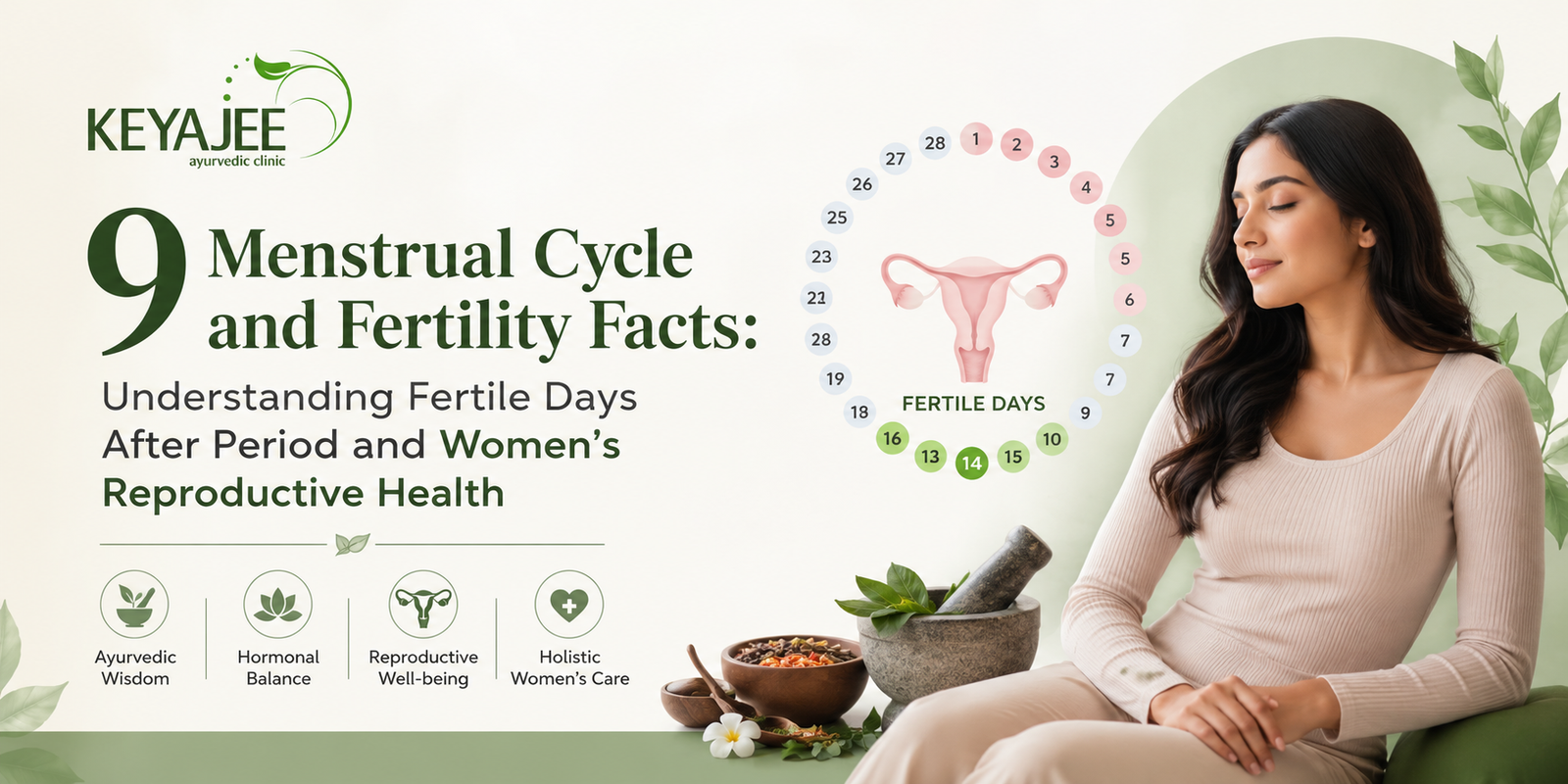
The menstrual cycle and fertility are closely linked, yet most women are taught surprisingly little about how the two connect. Understanding what happens across a cycle, and when conception is actually possible, is useful whether you are trying to conceive, avoiding pregnancy, or simply wanting to understand your own body.
Below are nine evidence-based facts about the menstrual cycle and fertility, along with how traditional Ayurvedic thinking views each stage.
- The Menstrual Cycle and Fertility Follow Four Distinct Phases
A cycle is divided into four phases: menstrual, follicular, ovulatory, and luteal. Day 1 is the first day of proper bleeding, not spotting. A normal cycle ranges from 21 to 35 days, and variation between individuals is completely typical.
Ayurveda describes these phases through the doshas: menstruation as Vata-dominant (movement and downward flow), the follicular phase as Kapha-dominant (building and nourishing), ovulation as Pitta-influenced (transformation and heat), and the luteal phase returning to Vata. It is an old framework, but it maps closely onto what hormone charts show.
2. Ovulation Days in Cycle Are Not Fixed at Day 14
The “Day 14” rule comes from averaging 28-day cycles, and it misleads a great many people. Ovulation happens 12 to 16 days before the next period, which means you count backwards, not forwards.
- 28-day cycle: ovulation around Day 14
- 32-day cycle: ovulation around Day 18
- 24-day cycle: ovulation around Day 10
The luteal phase (ovulation to period) is fairly consistent within an individual. The follicular phase is what varies, which is why longer cycles mean later ovulation.
3. After Your Period, When Are You Fertile? Often Earlier Than Expected
The fertile window spans roughly six days: the five days before ovulation plus ovulation day itself. This is because sperm can survive up to five days in fertile cervical mucus, while the egg itself is only viable for 12 to 24 hours.
For someone with a 24-day cycle who bleeds for five or six days, the fertile window can begin almost as soon as bleeding stops. This is the main reason the “safe days after period” idea is unreliable for anyone with shorter or irregular cycles.
4. Body Temperature During Ovulation Rises, But Confirms Rather Than Predicts
Basal body temperature (BBT) sits around 36.1 to 36.4°C during the follicular phase. After ovulation, rising progesterone pushes it up by roughly 0.3 to 0.5°C, and it stays elevated until the next period.
The limitation is timing: the shift appears after the egg has been released. BBT charting is therefore excellent for confirming that ovulation occurred and for identifying patterns over several months, but poor for catching the fertile window in real time.
For accurate readings, take your temperature immediately on waking at the same time each day, before sitting up, drinking, or speaking, using a thermometer that reads to two decimal places. Illness, alcohol, and disrupted sleep all distort results.
5. LH Level for Ovulation Provides Advance Warning
Luteinising hormone does what temperature cannot. It predicts. The LH surge occurs 24 to 36 hours before the egg is released.
Baseline LH generally sits between 5 and 20 mIU/mL, with the surge typically exceeding 25 mIU/mL. Ovulation predictor kits detect this in urine. Testing in the early afternoon tends to work better than first morning urine, because LH is produced in the morning and takes several hours to appear in urine.
One caveat: women with PCOS often have persistently raised LH, which can produce repeated positive results that do not correspond to actual ovulation.
6. The Best Time to Check for Ovulation Depends on Cycle Length
Testing at the right time avoids wasted kits and false reassurance. A reasonable starting point:
- 28-day cycle: begin testing around Day 10
- 32-day cycle: begin testing around Day 14
- Irregular cycles: begin around Day 8 and test daily
Combining methods gives a far clearer picture than any single one. Cervical mucus observation identifies the window opening, LH testing pins down the surge, and BBT confirms afterwards that ovulation actually happened.
7. Cervical Mucus Is a Reliable and Free Fertility Indicator
Cervical mucus changes predictably across the period cycle, and fertility can often be identified from these changes alone:
- Just after menstruation: dry or very little mucus
- Approaching ovulation: creamy, white, gradually increasing
- Peak fertility: clear, slippery, stretchy, similar to raw egg white
- After ovulation: thick, sticky, cloudy, or absent
The egg-white stage is the strongest signal that the fertile window is open. Ayurveda traditionally assessed reproductive health partly through the quality of these secretions, considering them an outward sign of shukra dhatu, the reproductive tissue.
8. Ayurveda for Pregnancy Traditionally Begins Before Conception
Classical Ayurvedic texts describe garbhadhana samskara, a preparation period for both partners, generally around three months before attempting conception. The reasoning is straightforward: sperm take roughly 72 days to mature, and follicles develop over several months, so what happens before conception matters.
Traditional ayurveda pregnancy care emphasises:
- Digestive strength, on the principle that reproductive tissue is nourished by well-digested food
- Cycle regularity, supporting predictable ovulation
- Sleep and stress management, which modern research links directly to hormonal regulation via cortisol
- Nutrient-dense foods such as ghee, milk, soaked almonds, and dates
- Gentle cleansing (shodhana) before conception only, never during pregnancy
Common ayurveda tips for pregnancy preparation include abhyanga (warm oil self-massage), favouring warm cooked foods over cold and raw ones during menstruation, and maintaining a consistent sleep schedule.
9. Ayurveda During Pregnancy Changes Month by Month
Once pregnancy is established, the approach shifts entirely. Ayurveda during pregnancy follows masanumasika pathya, month-by-month dietary and lifestyle guidance corresponding to the stages of fetal development described in the classical texts.
Guidance for pregnant women typically emphasises warm, easily digestible, nourishing food; gentle movement; emotional wellbeing; and careful attention to what is safe.
That last point deserves emphasis. Many herbs commonly used to support fertility are contraindicated once pregnant. Self-prescribing herbal preparations during pregnancy carries real risk, and any herbal use in pregnancy should be discussed with both a qualified practitioner and your midwife or doctor.
What This Means in Practice
The most useful thing you can do is track. Three to six cycles of honest record-keeping, covering cycle length, mucus changes, basal temperature, and LH results, will tell you more about your own fertility than any general rule ever could. Patterns that look random over one cycle usually resolve into something predictable over six.
Some signs warrant medical assessment rather than self-management: cycles consistently shorter than 21 days or longer than 35, periods that stop for three months or more without pregnancy, pain that interferes with daily life, very heavy bleeding, or twelve months of trying to conceive without success (six months if you are over 35).
Ayurvedic approaches work best alongside conventional care, not instead of it. Conditions such as PCOS, endometriosis, and thyroid dysfunction all affect the menstrual cycle and fertility, and all benefit from proper diagnosis before any complementary approach is considered.
Frequently Asked Questions
Can you get pregnant during your period?
It is uncommon but possible, particularly with short cycles. If you have a 22-day cycle and bleed for six days, ovulation could occur around Day 10, and sperm from intercourse on Day 6 may still be viable. Bleeding is not a reliable indicator of infertility.
How many days after my period am I fertile?
There is no universal answer, because it depends on cycle length. Ovulation occurs 12 to 16 days before your next period, and the fertile window opens about five days before that. With a 28-day cycle and a five-day period, fertility typically begins around Day 9 or 10. With a 24-day cycle, it may begin within a day or two of bleeding stopping.
What is a normal LH level for ovulation?
Baseline LH generally sits between 5 and 20 mIU/mL. The surge that triggers ovulation typically pushes it above 25 mIU/mL. Ovulation predictor kits detect this threshold rather than giving you a number. Persistently high readings without a clear surge can indicate PCOS and are worth discussing with a doctor.
How much does body temperature rise during ovulation?
Roughly 0.3 to 0.5°C, sustained for the rest of the cycle. A single high reading means nothing; what matters is a sustained shift lasting three or more days. Illness, alcohol, poor sleep, and taking your temperature at inconsistent times all produce false readings.
Is it possible to ovulate without having a period?
Yes. Ovulation can occur before a first period returns after childbirth, after stopping hormonal contraception, or during perimenopause. This is why breastfeeding alone is not a dependable contraceptive method.
Can you have a period without ovulating?
Yes. These are anovulatory cycles, where bleeding occurs without an egg being released. They are common in adolescence, perimenopause, and in conditions such as PCOS. BBT charting is one of the simplest ways to detect them, as there will be no sustained temperature rise.
How long should I track before drawing conclusions?
At least three cycles, ideally six. One cycle tells you very little; several reveal patterns in cycle length, ovulation timing, and luteal phase length that are genuinely useful.
Does stress actually affect ovulation?
Yes. Sustained stress raises cortisol, which interferes with the hypothalamic signalling that drives the cycle. The most common result is delayed ovulation, which lengthens the cycle. This is one area where Ayurvedic emphasis on sleep, routine, and nervous-system regulation aligns closely with the modern evidence.
Are Ayurvedic herbs safe during pregnancy?
Not automatically. Several herbs used to support fertility are contraindicated once pregnant, and some traditional preparations have raised safety concerns regarding heavy metal content. Any herbal use during pregnancy should be discussed with both a qualified practitioner and your midwife or doctor.
When should I see a doctor about my cycle?
If cycles are consistently shorter than 21 days or longer than 35, if periods stop for three months or more without pregnancy, if pain interferes with daily life, if bleeding is very heavy, or after twelve months of trying to conceive without success, or six months if you are over 35.
Do irregular cycles mean I am infertile?
No. Irregular cycles make timing harder and can signal an underlying issue such as PCOS or thyroid dysfunction, but many women with irregular cycles conceive. The practical difficulty is identifying the fertile window, which is where LH testing and mucus observation become especially useful.
This article is for general information only and is not a substitute for individual medical advice. Please consult a qualified healthcare professional about your own circumstances.
edic emphasis on sleep, routine, and nervous-system regulation aligns closely with the modern evidence.
Are Ayurvedic herbs safe during pregnancy?
Not automatically. Several herbs used to support fertility are contraindicated once pregnant, and some traditional preparations have raised safety concerns regarding heavy metal content. Any herbal use during pregnancy should be discussed with both a qualified practitioner and your midwife or doctor.
When should I see a doctor about my cycle?
If cycles are consistently shorter than 21 days or longer than 35, if periods stop for three months or more without pregnancy, if pain interferes with daily life, if bleeding is very heavy, or after twelve months of trying to conceive without success — six months if you are over 35.
Do irregular cycles mean I am infertile?
No. Irregular cycles make timing harder and can signal an underlying issue such as PCOS or thyroid dysfunction, but many women with irregular cycles conceive. The practical difficulty is identifying the fertile window, which is where LH testing and mucus observation become especially useful.


